


Inter-Row Precision Air Conditioner for Data Center | JXCooling
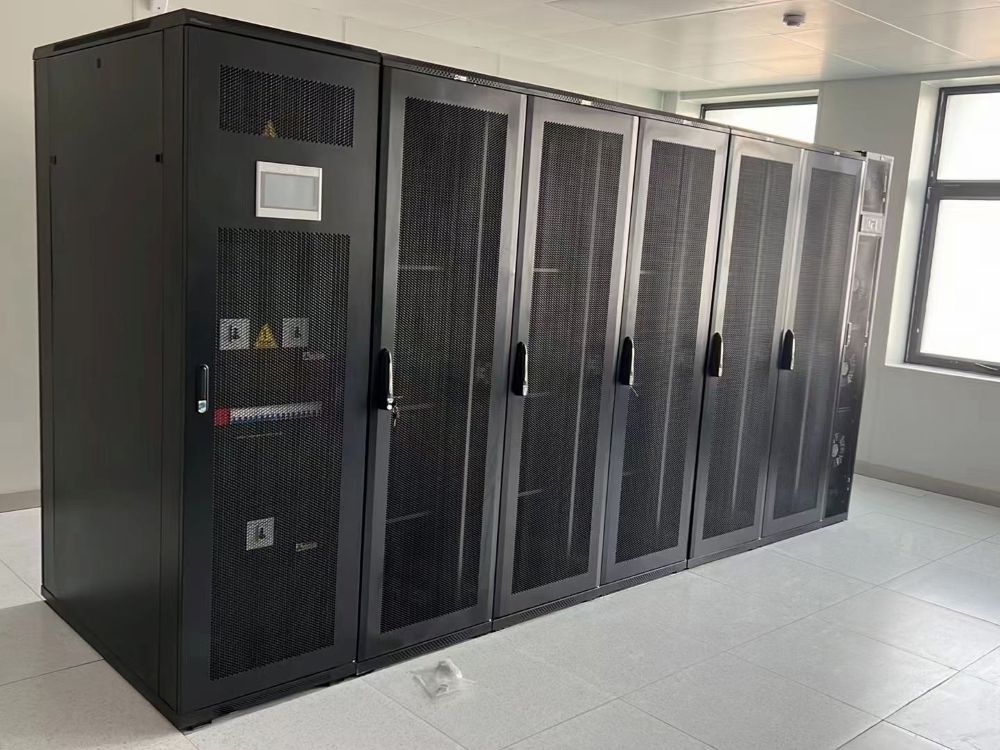
JXCooling Inter-row Precision Air Conditioners are designed for close-coupled cooling in modern data centers, installed between server racks to remove heat at the source. By shortening the airflow path and reducing mixing between hot and cold air, inter-row cooling improves temperature stability, supports higher rack densities, and enhances energy efficiency—especially in hot-aisle/cold-aisle or contained aisle environments.
Inter-row units deliver conditioned air directly to the cold aisle (or rack inlet zone) while drawing return air from the hot aisle, helping maintain stable supply temperatures for critical IT equipment. This architecture is ideal for high-density racks, modular data centers, edge computing rooms, and HPC/AI clusters where traditional perimeter cooling struggles to control hotspots.
Why Inter-Row Cooling?
Cool close to the load: Reduces hot/cold air mixing and eliminates local hotspots
Higher rack density support: Improves inlet temperature uniformity across racks
Lower fan energy: Shorter airflow distance reduces static pressure requirements
Scalable by row: Add cooling capacity as IT load grows (module-by-module)
Works well with containment: Optimized for hot-aisle/cold-aisle containment strategies
Typical Applications
High-density rows in enterprise data centers
Modular/Containerized data centers
Edge computing rooms and telecom data hubs
HPC / AI clusters with concentrated heat loads
Retrofit projects targeting hotspot elimination and efficiency upgrades
Key Features
Precise Temperature Control
Microprocessor-based control maintains stable supply air temperature and protects IT inlet conditions under dynamic load changes.
High-Efficiency EC Fans
Variable-speed EC fans provide efficient airflow modulation, reduced noise, and improved part-load performance.
Close-Coupled Airflow Design
Engineered air paths for hot-air return and cold-air supply improve separation and reduce recirculation.
Intelligent Monitoring & Integration
Supports data center monitoring and BMS integration (typical options include RS485/Modbus, and optional SNMP/BACnet/Ethernet, project-based).
Reliability & Protection
Comprehensive alarms and protection logic (fan status, temperature sensors, high/low pressure where applicable, filter/airflow supervision, and fault logging).
Technical Parameters (Inter-Row Precision Air Conditioner)
| Product | Cooling capacity | Power supply | Refrigerant | Compressor | Fan Type | Control Function | Communication |
| JX-125000 | 12.5KW | 3~380VAC | R410A | Scroll Compressor | EC Fan | Constant Temperature & Constant Humidity | RS485 |
| JX-250000 | 25.0KW | 3~380VAC | R410A | Scroll Compressor | EC Fan | Constant Temperature & Constant Humidity | RS485 |
| JX-350000 | 35.0KW | 3~380VAC | R410A | Scroll Compressor | EC Fan | Constant Temperature & Constant Humidity | RS485 |
Photos
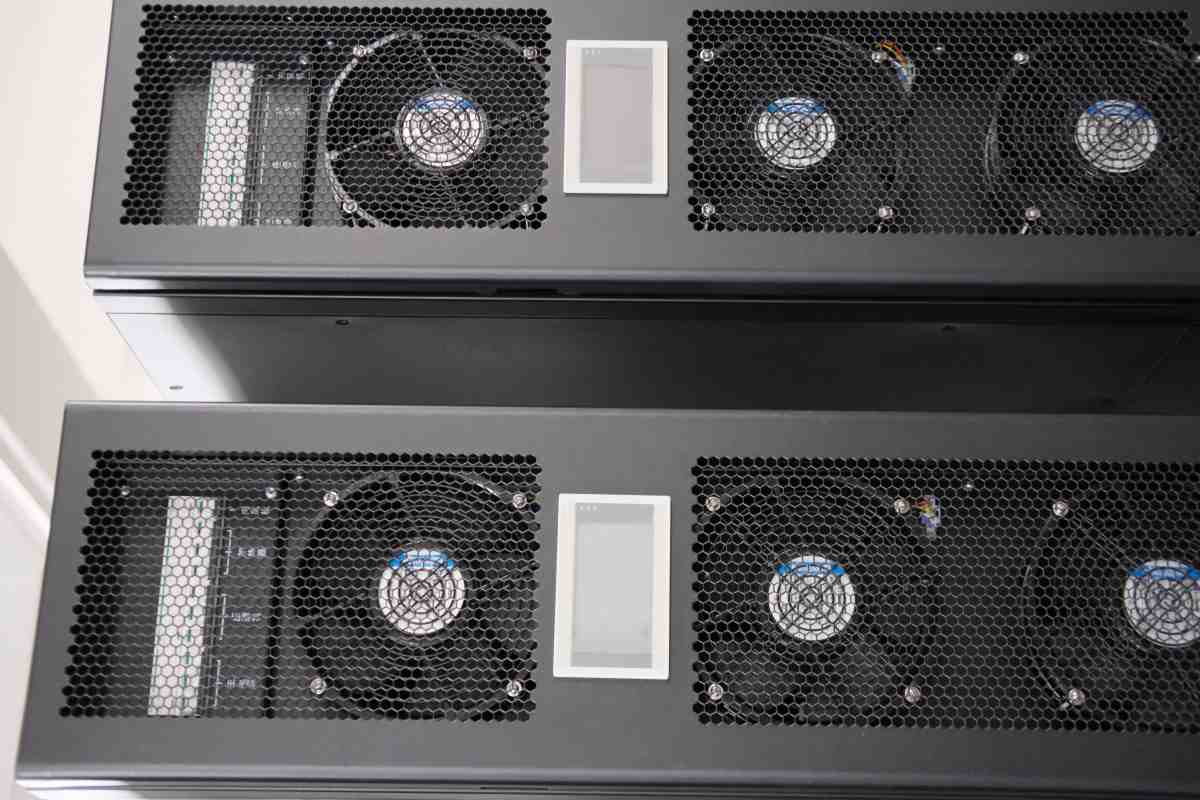
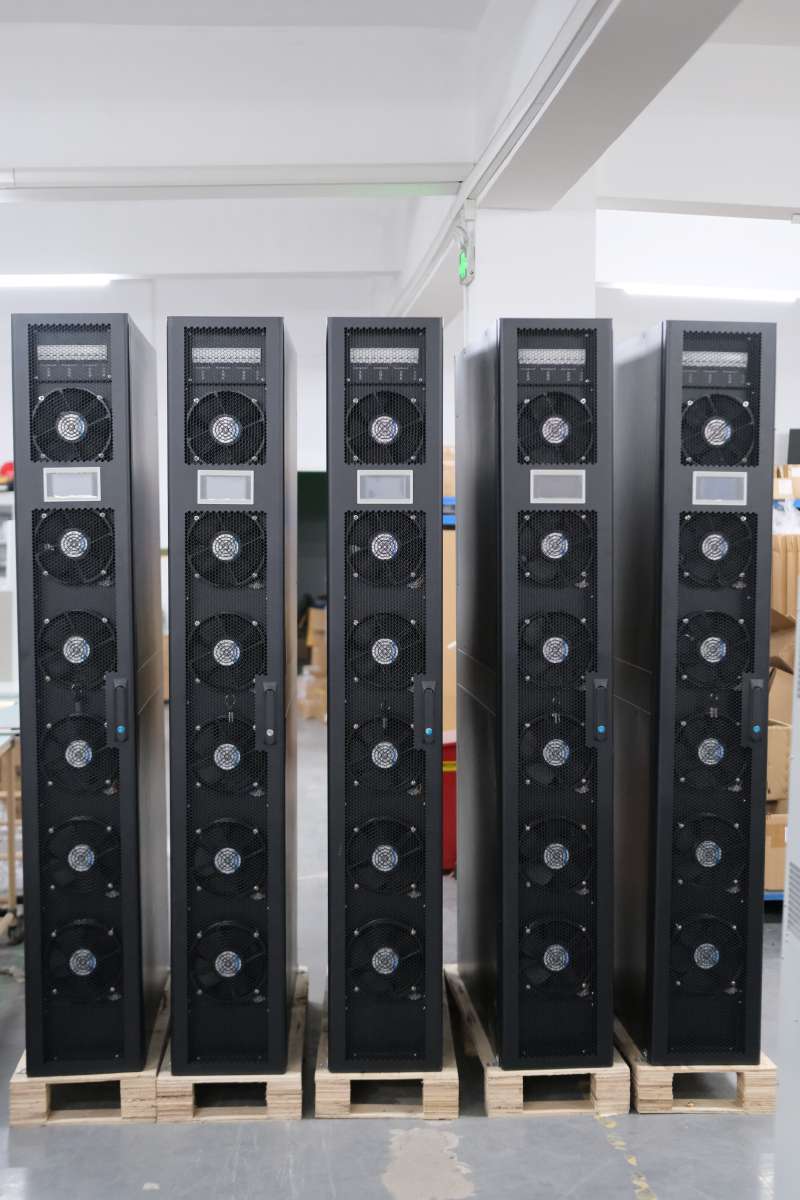
System Options (Project-Based)
JXCooling inter-row units can be configured to match different site architectures:
DX (Direct Expansion) Inter-Row Unit
Suitable for sites requiring independent, modular cooling without chilled-water infrastructure.Chilled Water Inter-Row Unit
Ideal for plants with chilled water systems and central cooling efficiency requirements.High sensible cooling focus
Optimized for data centers where sensible load dominates (typical for server rooms).
Final configuration depends on room design, redundancy level, and available utilities.
Airflow Concept (How It Works)
Return air intake: Hot air is drawn from the hot aisle / rear rack zone
Heat removal: Cooling coil/refrigeration removes heat efficiently
Supply air discharge: Conditioned air is supplied toward the cold aisle / rack inlet zone
Result: Improved inlet temperature stability and reduced hotspot risk
Inter-row cooling performs best when paired with:
Hot-aisle/cold-aisle layout discipline
Containment (optional but recommended)
Proper blanking panels and cable management to prevent bypass airflow
Key Benefits for Data Center Operations
Better IT protection: stable inlet temperatures reduce thermal alarms and throttling
Energy savings: reduced mixing and improved part-load fan control
Faster deployment: row-based modules simplify expansion and planning
Space-efficient: cooling capacity placed within rows rather than perimeter-only layouts
Operational visibility: remote monitoring and alarms support proactive maintenance
Selection Guide (What We Need From You)
To recommend an inter-row solution, please provide:
Total IT load (kW) and expected growth plan
Rack layout (number of racks, row length, hot/cold aisle arrangement)
Target rack inlet temperature and allowable range
Containment strategy (none / cold aisle / hot aisle)
Available utilities (DX power, chilled water parameters, etc.)
Redundancy requirement (N, N+1) and preferred control strategy
Monitoring protocol requirement (Modbus/SNMP/BACnet)
Installation Notes
Place inter-row units strategically to balance airflow along the row
Maintain recommended clearances for service access and airflow
Ensure condensate drainage and leak protection measures as required
Commission with airflow verification at rack inlets (temperature mapping recommended)
Integrate alarms and monitoring into DCIM/BMS for centralized oversight
Maintenance
Regular filter inspection/cleaning (site-dependent)
Coil and fan checks during planned maintenance windows
Sensor calibration verification and alarm log review
Confirm containment integrity and eliminate bypass airflow sources
FAQ
Can inter-row cooling work without containment?
Yes, but containment significantly improves performance by reducing mixing and improving predictability.
Is inter-row cooling suitable for retrofits?
Yes. It’s commonly used to address hotspot problems and support higher rack density upgrades.
Which is better: DX or chilled water?
It depends on site utilities and efficiency goals. DX is modular and independent; chilled water integrates with central plants.
Request a Design / Proposal
Send your rack layout, IT load (current and future), and target inlet conditions. JXCooling will propose an inter-row precision cooling plan including recommended unit quantity/placement, redundancy strategy, and monitoring integration for your data center.